Friday, 25 April 2014

Ancient Temple tombs

Our day started with a full shampoo and shower for our motorhome, which is still behaving itself; while we attacked an early morning Turkish Kahve, which is as thick as mud and has half a cup of grounds in the cup when you are finished.  A tractor was also getting the full spa treatment at our little Oto Yikama probably because these are often used as the main vehicle for many a dad, mum and kids: to market, to school, then on into the fields: terribly versatile.

Our van and a tractor and trailer in for a car wash

We drove on to Dalaman with many a pullover on any available belvedere for views down to the beautiful blue patches of the Mediterranean. 

The Med in the distance
We are now in the south of Turkey and the days are getting warmer: tho’ not uncomfortably so, as yet.  At Dalaman, we eventually hunted down a train station that was built there by mistake. It is probably the only train station on earth that has no rail line to it, so no train has ever visited.  

A shipping delivery error was the cause.  

Abbas Pasha, the viceroy of Egypt, in 1906, decided he loved the wildlife at Dalaman so much he would build himself a country lodge there.  At the same time, he was in the process of ordering a new railway building to be set up in Alexandria.  The orders were mixed up.  The building material for the lodge went to Alexandria while the train station was delivered to Dalaman; and in the end built there, as the shipping costs to correct the error were far too prohibitive.  Today, the train station has been remodelled and seems to be the administrative headquarters for some sort of extensive state farm that grows fruit trees and agricultural crops and is all decked out in date palms and green lawns.

The train station that never was
After lunch we headed to Dalyan, which for thousands of years was home to the Lycian kings.   The myths to do with the origins of these kingdoms are delightful, and it is not surprising that Homer included them in his epics.  

It was said that Caunos, son of Miletus, was in love with his twin sister, Bibylis.  Sternly disapproving, Miletus sent Caunos away.  Caunos settled on a knoll here, overlooking where a natural harbour once existed: but today it is covered in reed beds, sand and marsh.  He built his home and kingdom, but the river that runs right past it, out to the Mediterranean, is said to be made up of the endless tears of Bibylis, so distraught at his loss, she killed herself when he was sent away.  

Caunos’s Lycian kingdom was one of the small but well functioning trading kingdoms along this stretch of the Mediterranean, way back in the 3rd BC.  Greek was spoken, and they showed a preference for Hellenistic architecture; but the Lycians were Anatolian in their identity.  

Their small ships plied the Mediterranean most likely trading salt, salted fish and dried figs, and while they struck up strategic alliances, they generally stayed very Swiss in their attitude: playing quite a neutral role in these parts, keeping themselves to themselves, and maintaining their wealth.


The hill where Caunos built
The Lycians often built burial chambers close to where they lived, following quite eastern traditions.  Their dead were then seen as still a part of the living.  But, when conditions allowed, as at Dalyan, they created glorious and spectacular tombs for their kings, carving them out of the limestone cliffs, creating works of temple art on sheer perpendicular walls, because they believed that the soul of the dead would be carried off, like a winged creature, into the Netherworld, and that this height would give them a head start.  

Extraordinary work.

The rock tombs, which were part of the necropolis at Dalyan were long ago looted, despite written curses on many of them for those who attempted such a pillage.  Tomb robbing was apparently a well developed money-earner, even then: worse risking a curse for.


The smaller plain ones for humble citizens

The larger rock tombs look like temples with colonnaded frontages, bas reliefs and engraved drawings using figures from myths and funeral feasts as the subject matter.   The smaller ones for the less wealthy are plain and unadorned, and lower down on the cliff wall. 
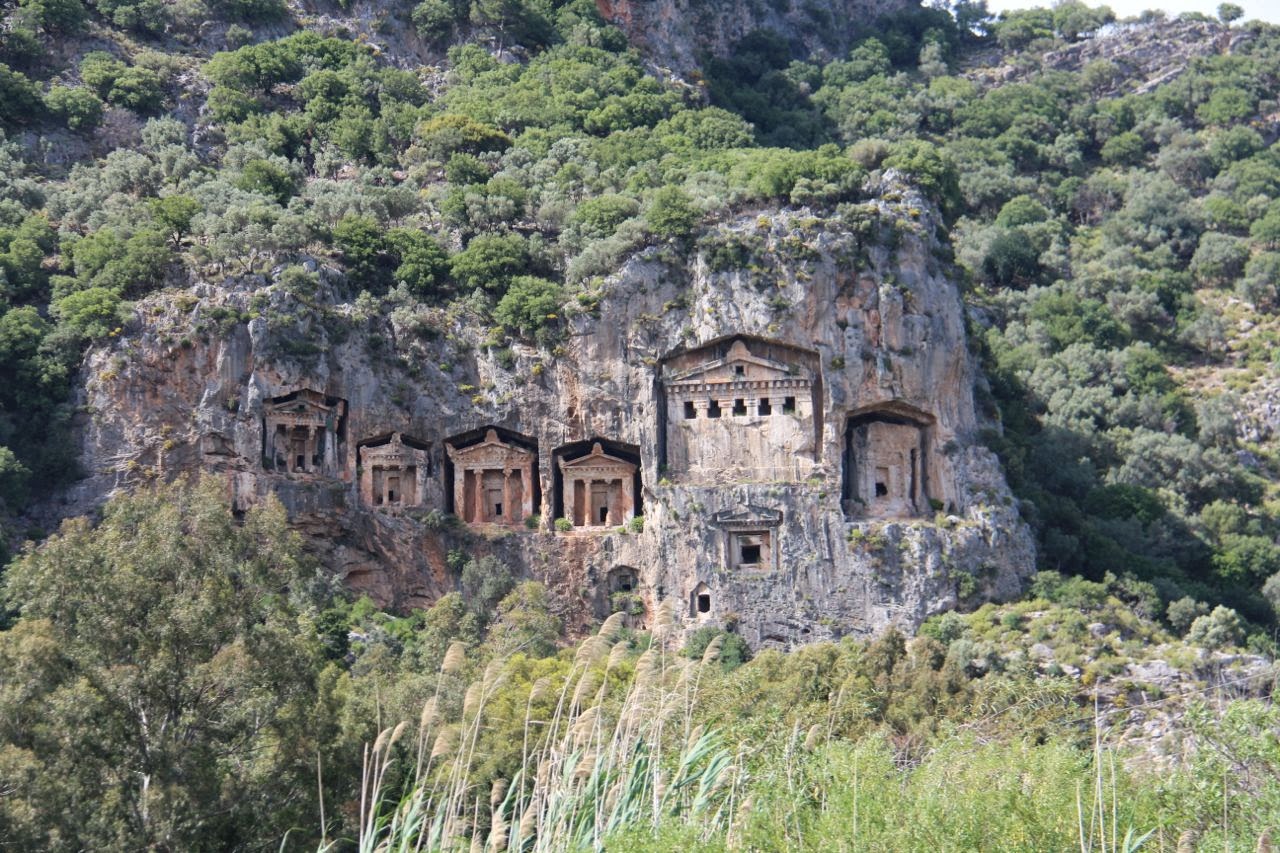

Beautiful Lycian tombs
Small water boats today carry tourists through the pretty reed beds to view the monumental rock art, then on to the remnants of Caunos, which are fairly bereft, and quite poorly signed, as yet: more archeology needs to be done here.   Despite that it really is amazing just to walk where Caunos once walked.  We found it hard to leave so camped directly opposite the Necropolis, and ate our dinner just as the lights came on, illuminating the tomb art. 


Fresh sea bass, grilled

Lovely though it is, the lake, the reeds and the watery world beneath the monumental rock tombs, it is not hard to understand why many of the graves are there.  The inhabitants of this part of the world were was often described as having  a ‘greenish cast’: very likely the effects of malaria: the curse of much of the Mediterranean coast in times long past.  

Our view at dinner

No mosquitos tonight, thank goodness.  


oooOOOooo

Wednesday, 23 April 2014

Picnic in paradise


It is a public holiday today in Turkey so people are having fun.  I printed a calendar while we were at home showing the Turkish Public holidays so we would know them,  and ours says today is National Children’s Day,  so it may be, and certainly children are the focus of most of today’s fun.  

Tho’, at our campsite the night before, near Bodrum, our neighbours were settling in for the morrow making a coil for a still;  most likely not for kids.  As well, they had great vats of the stuff brewing behind their tent, which they clearly figure they will need, as we think they told us they are retired  and are here for an extended period: until  December.   

Making hooch, while camping
They were also a dab hand at rolling their own cigarettes; and none too shabby with mechanics, as they spent much of the early evening repairing their outboard motor with the help of some amazingly dodgy tools. Notwithstanding, they got the outboard motor to work.

Hand rolling their cigarettes
The day started with children marching in the street above our camp.  Lots of Turkish music was being belted out by drummers and band members, and small children in costumes enjoying their procession.    

Children in procession 
Across country we drove past parks filled with families and music, having fun; down to the Marmaris peninsula, again through mountains.   The roads through these coastal ranges have many full turn switchbacks but have been beautifully built.  

Turkey seems to have so much money to do so many things well, such as these roads.  Actually, they are the sixth richest economy in Europe at the moment, so we should not be so surprised.  They have survived the global financial crises moving forward, not backward as has happened with other countries here;  and appear to be managing their money well.  They also have more billionaires in Istanbul than in any city other than New York and Moscow, and sometimes they tie with London.  And even their airline, we read, has been voted by Skytrax as the best in Europe every year for the last three years.

Fertile valley views
The views down into the fertile valleys are glorious.  And, again, there are fruit trees and crops everywhere.  Tons of oranges are ripe at the moment, being sold on covered market stalls set up on the side of the road. Too many really to sell to travellers.  They surely must have other outlets for this produce: there is just so much that would go to waste, if not.  

Turkey is so fertile.  It produces an amazing variety of foodstuffs:  pomegranates, hazelnuts, quinces, figs, pistachios, eggplants, green peppers, lentils, tea, tobacco, wheat, rye, lemons.  You name it, they grow it.  For many foodstuffs they are the world’s largest grower.  In a time of crisis you would feel quite safe being in Turkey, as the climate is so beautiful, the soil so rich, that the country is completely self sufficient in food production, and has been since the 1980s.  So, it would be hard to go hungry here. 

Admiring it all we drove down to the coastal town of Marmaris, but woe! here we saw bacon and eggs, and fish and chips advertised on many a street corner menu, so figured this for a British package holiday destination, so back into the car we dived and bolted to the glorious Datça peninsula, a much better choice for us.  

Datça peninsula
Though the first campsite we found was uninhabitable, despite an idyllic waterfront view with an even more idyllic restaurant selling Izhgara Balek (grilled fish), fresh from the sea, on the menu tonight. 

Most campsites, as in Greece, only open for July and August: the summer.  So, many are still in the state they were left in last August when their owners tootled back to Istanbul for the winter.  I doubt they are the millionaires, there, though.  The campsites look as though winter leaves and spiders have taken up permanent residence in many of the amenties blocks.  Sometimes there is a caretaker left behind who keeps a small section clean.  Other times not.  As tonight at our first stop.   

So we moved on, and found a glorious stretch of bay, still not ready, but, at least, there was a caretaker handy with a screw driver, as he hard-wired us into exposed wires:  the power; and set us up with a water view second to none.

And then there was power
Picnic tables down one end of the beach were occupied by families on holidays.  Dads and sons were skipping stones on the surface of the water.  Children were crab-fishing and swimming from the dock.  

Dads out with sons
One boy managed to stab a ray, which drew an admiring crowd of kids.   

One caught a ray

Men were making tea, the Turkish way, while the ladies rested. Everyone relaxed and happy.

Men at work
Woodsmoke filled the air and with the high beautiful mountains on all sides we could have been camping Canada.


Rustic, rural, magic

The smell from barbecues was fabulous.


Peaceful haven 
The picnic area closed by eight, leaving us as the sole occupants of this long length of million dollar waterfront. 

Catching fish 

And we slept like babes.  
oooOOOooo


Tuesday, 22 April 2014

Tale of a tomb

Mausolus married his sister Artemisia.  He ruled a small kingdom on the west coast of Turkey. At the time the family were Satraps of Persia around 400 to 300 BC and in order to keep the power and influence  close, it was customary to marry within the family.  All the ruling brothers did.  Genetics notwithstanding.  

Coins with Mausolus's image
When Mausolus became king he moved his capital to where Bodrum is today.  He spoke Greek, loved all things Greek, and everything he built throughout his coastal kingdom was heavily influenced by beautiful Greek designs. 

Particularly his tomb.  

Built overlooking the blue waters where the Aegean meets the Mediterranean his tomb took so long to construct it was only completed after his death.  Artemesia, wracked with grief, sped up the stone work, employing only the best cutters in the world, spending vast amounts of the tax payer’s money in so doing. 

Scopas, who built the Temple of Artemis at Ephesus came south to help, so the tomb had the look of a temple about it. Stairs with stone lions on guard climbed to a courtyard beneath which was the sarcophagus chamber.  The courtyard was guarded on four corners by stone warriors on horseback. Up rose the tomb to a great height in massive square blocks decorated in ornate reliefs offset with columns.  High on the tomb top massive stone statue of Mausolus and Artemisia was placed, their chariot into the Netherworld, led by four horses.  

Glorious tomb
When Artemesia died of grief and loss not long after Mausolus’s death their bodies were placed in a sarcophagus in the burial chamber. The stairs to the sarcophagus were blocked by a double door of white marble.  Offerings were placed on the stairs: raw butchered meat from many different animals, alabaster jars of perfume,  fine pottery, ivory and semi precious stones.

Diadems on display at the castle
So amazing was the tomb that sightseers came from far and wide to visit.   It came to be known as one of the Seven Wonders of the Ancient World.  From this large beautiful tomb we get our word, Mausoleum.  

Remnants of the tomb
But there are almost no remains today, apart from fallen shards and column pieces and the deep indentation of the tomb chamber, for when the Knights of the Hospitallers with their headquarters in Rhodes, were tightening their hold on this part of the world, they strengthened Mausolus’s Castle, further down the hill, robbing stone from his beautiful tomb.  Though pirates had been there before them, robbing it clean.  

Blocky castle rebuilt with tomb blocks
Bodrum Castle is today a museum, filled with artefacts from sunken ships: exquisite ancient glass and a massive variety of amphorae used as the shipping containers of old, for wine, olive oil, grains and seeds.  

Love the shapes
It is a big, blocky stronghold with many ancient stairs and towers with views in all directions, just as Mausolus planned. From here he could see every ship in the surrounding waters.  

View from the Castle
Today, on the grounds of Mausolus’s city,  Bodrum’s shores are lined with expensive boats so closely moored that you can barely see the sea. Endless masts and rigging interrupt the view.  Expensive blinding white homes line narrow little streets and lanes, some for sale for 15 million Turkish Lira.  Smart restaurants and nautical boutique shops abound. 


One of the pretty lanes
Bodrum today is the playground of the international rich and famous.  

With all the odd bling
But, come to think of it, given Mausolus’s taste and predilections it quite possibly was, even then. 

But, still, there are humble fish sellers around

oooOOOooo

Monday, 21 April 2014

A long and winding day

After Aphrodisias we set off to find a campsite and stopped for shepherds with their crooks grazing their goats and sheep in amongst the Roman ruins, much as they have always done.  

Mum is shepherding while sitting up on the knoll
So many country folk spend much of their day with a dozen or so of their animals in this part of the world.  Life must be so slow for them; so very close to nature.  

We found a restaurant that allowed camping in the garden, so we parked on their concrete dance floor in under the trees,  and as nothing was operational for the summer yet we had the place to ourselves, including all the amenities.  One of the helpers bought us over a table and chair for three, hot apple tea,  and lots of hand kisses for me.   Very welcoming.  And before we used the bathroom and shower the next morning it was all completely cleaned by two different burly fellows, mops in hand.   Lovely country service.  We still don’t understand why there were so many staff when the restaurant was not yet open for the summer.  Some things remain complete mysteries to us, without the language to ask.  

We had not driven 10 minutes heading over the mountains for Bodrum the next morning when the van broke down again.  Something snapped, Pete said, and black smoke belched out the side of the vehicle as it lost momentum.  We pulled over and phoned our hire camper contact with the last of the money on our prepaid sim to let him solve the problem as before; then dealt out the cards and spent the next hour with Bec whipping us at Black Mariah, among the forestry and rubble on the side of a great mountain.  

Broken down along a back road
Two technicians came in a small car and after poking around under the bonnet for a short while said what we think meant: we had a problem that they couldn’t fix and we would need to be towed to the nearest town.  Which we had expected , so were not too surprised.  

They then sat down and had a cigarette on the side of the road.  But after only a few drags of nicotine one of them snapped his fingers, dived under the van, and came up smiling.  He sent his apprentice over to their dusty car to pull off some clamp from their innards.  This he fitted to ours.  The apprentice then wired something into theirs as a replacement.  The mechanic then drove us off, with the apprentice following, and our van appeared fixed as the smoke had disappeared and we were moving.   
Even mechanics have tea breaks
About 15 kilometres further on he stopped at a small village that had a series of very busy workshop bays for fixing cars along the side of the road.  Where on earth did all these disabled cars come from?  There was hardly any traffic on our road at all.  There, our man must have bought a dedicated part from them, as we think he installed that while we all were given tea — a must! and delicious! — and he must have taken back his own clamp and re-installed that in his car, as well.  We’re not sure, we were side-tracked with the tea.   Anyway, we were all fixed in under two hours; with lots of smiles, hot tea and more hand kisses.  And the 80TL ($AUD40) it cost is to be refunded by the company.  So, a good outcome with very little hassle.

Each bay has a mechanic busy with a breakdown
As we filled up with diesel on the edge of town we noticed the gas station had a small prayer room, a Mesquit, behind the hotel with Bay for men; and Bayan for women on it.  At first we thought they were toilets, but on opening the door found the tiny Mesquits with their ablutions alcove, slip on shoes, prayer rugs, and worry beads.  For travellers, I guess.  Very thoughtful.  

Mesquit at gas station
By now, it was lunch time so at the first place that offered food we stopped;  the van, again, was running smoothly.   As usual, the restaurant was staffed by men: always a dedicated oven man in charge of the burning log fire.   

Delicious chicken casserole in clay pot
They had dried peppers, eggplants, chilli and tomatoes hanging on a rack that we were admiring,  and after we’d ordered lunch from their food photos, they bought over plates of the dried chilli and eggplant for us to sample. 


Dried produce
We ordered and our table ended up laden with a veritable feast: chicken casserole in a clay dish;  meatball and cheese in onion and tomato sauce in another terracotta dish; both fired in the bread oven and  a spinach and feta pide. 

Slices of tomato, dried then powdered 
All freshly made and hot from the oven, along with masses of plain sliced bread, a delicious salad dressed with lemon; and more  tea,  plus a big whole wheel of fresh bread that will last us three days. 

Fresh bread
  All for $AUD18 in total.    I do not know how they do it.  

Our delicious lunch
Lunch over we headed off after more hand kisses, and thanks. There were six or seven long mountain climbs in front of us before we got back to the coast.  The roads here are good, and getting even better, as construction is going on constantly.  Enormous mountains of soil and rubble have been gutted to build and rebuild them.  The Turks seem to be accomplished at all sorts of building and engineering from days long past.  The only trouble is that occupational health and safety is not seen as a real issue here yet in many of these Mediterranean countries; at least, not to the extent that it is enforced in Australia;  so great slabs of roadway at the edge of the shoulders often just fall away very raw, often with a drop of feet, without any warning sign or cautionary boundary guard rails present.   So, to avoid tyres being slashed, or falling off the side of the road, you do need to take extra care even when the roads are good. 

We’d been noticing that all the houses around have great woodpiles made from branches of fine trees; and they all have vegetable gardens, often under tunnelled canopies of plastic.  We stopped for a quick photo.  But, it wasn’t that quick. 

Twig wood piles and vegetable garden in each plot

Out came the owner and wanted to be in the photo, too.  He, then, insisted that Pete follow and showed him into one of the rooms in the house which turned out to be a little mini-bread making factory.  Clearly what the ladies spend a lot of time doing during the day: they are busy making bread. 

All the family females hard at bread making

In great rounds, as big as the saç on the wood fire.  

She rolls this as large as the saç
The bread dough is sectioned and rolled deftly on and off the long coned roller;  each of the ladies having dedicated tasks.  A wee production line. 

Moving from one to the other to the flame
And we were sent away with a wacking great weight of bread rounds wrapped in newspaper as a gift for calling.  

All without understanding a word of either language.  

Amazing hospitality.  

Back into the van we go, and as it is still functioning well, we head off into the mountains.     


oooOOOooo


Sunday, 20 April 2014

Poppies in the ruins

Aphrodisias is in the back of beyond, encircled by stone mountains.   We were heading there after Pamukkale but were dawdling for no reason other than we were relaxed.  


Spider decor
Our early morning coffee in Denizli came decorated with a spider’s web, delicious all the same.  Denizli has as its motto a rooster, of all things.  We have been seeing statues and live roosters everywhere since we came to this area, then discovered roosters are prized:  and finely and very competitively bred for their crow: the more melodious the better.


Denizli rooster
We are thinking that maybe they might train them to warble a bit, to replace some of the woeful Imam sounds, whose call to prayer is a little less than melodious.  

Our lunch time pide, with salad, cost all of $AUD2.  Not that everything is inexpensive, but some of the foodstuffs are so exceptionally priced it is not worth our while to bother making them.


Yum
And we always enjoy watching it being prepared. It is always fresh from a hot flame to you.   

We only realised it was Easter Sunday when we drove into a traditional rural village, Karahishar, after lunch, to find all the stores were closed, except the çay shops, of course.   The men were holding forth there, as usual, doing what men do most days. 

And, today, even the women were taking time out to sit outside their wee abodes, and dream. 


Resting today
We have seen no Easter eggs in rural Turkey, thus far.  They seem to have successfully resisted the commercial lures that the rest of us fall for.

We came to the ruins of Aphrodisias in the middle of the afternoon.  Like Pergamom and Ephesus, Aphrodisias eventually came under the auspices of the Romans, who set it up early on as a cult site to the love goddess Aphrodite, who it is said, was born of sea foam, and washed ashore on the beach of Cyprus in a seashell.


Aphrodite in heavy garb
A temple to Aphrodite was built here with exquisite Ionic columns and a below ground sanctuary for her cult statue, so special only Priests were able to view it.    Over time as Christianity took hold and the pagan idols were denied, Aphrodite’s temple was converted into a basilica: the columns and stones of the pagan sanctuary recycled for its expansion.   When the Seljuks came and did away with Christianity,  Aphrodisias became little more than a village until, finally, earthquakes put an end to even to that.


A plaque on the basilica wall identifying a rich sponsor
who helped pay for the basilica
Poppies now grow where 15,000 people once lived, worked, loved and prayed.


South Agora had a giant pool that doubled as a
reservoir when earthquakes ruins
the terracotta drainage
Aphrodisias is special for several reasons.  Its stadium is the best kept of its kind in the world.  It is unusually shaped, incorporating the u-features of Hellenistic stadia along with the oval of the Romans,  but it feels really cozy despite being able to accommodate 30,000 people.   

At this end were the blood sports
A quick spray of zero, a cushion or two , and much of the stadium might still be used today.  Though back in the day the favourite entertainment was likely blood sports and combat;  though javelin, discus and running would all have been draw cards here.  Albeit in the nude. A bit chilly for that, though, today. 

The other thing that made Aphrodisias special was the marble.  The mountains around here are heavy  with it.  With marble being so plentiful building material was never a problem.  Right there on the doorstep.


A tourist singing an aria for us in the theatre


They were interesting times.  Because, at the time the Attalids of Pergamom allied with Rome, Pergamom had been the major centre for stonecutting in Asia Minor.  All the great stone artists had been working there. But after the alliance, Pergamom descended into a city of riot and revolt.  Archaeologists and historians now believe that the specialist stonecutters from Pergamom might have moved themselves south to Aphrodisias, and set up a fine stone school there: teaching apprentices the art of sculpting and covering the place with their craftsmanship.  


Fine detail 

You cannot walk an inch in Aphrodisias without finding a fallen statue, a garlanded frieze, or the decorative base of an urn.  The apprentices and masters were busy. Stone is thick on the ground.   At one place on the site a collection of garlanded friezes has been stacked,  and these make a gorgeous  wall, and that is only the smallest portion of them.


Garland practise for the apprentice stonecutters
Sarcophogi and other beautifully carved stone pieces from Aphrodisias have been found all over the Greek and Roman world.    One of the reasons for this is that caravans of travelling salesmen would head off from these mountains with sarcophagi loaded on their camels.  All fully decorated, except for the heads, which were simply blocked and featureless.   Once sold, the salesmen-cutter would quickly chip away at the head to create the personal details for the buyer.  Made to order, so to speak.


Imagine this on a camel's back
Aphrodisias, too, is the home of a rare Sebastion: a temple to the Roman Emperors as gods, which has a processional route  porticoed at the sides rising three floors high exquisitely decorated with some of the most glorious friezes we’ve seen on any site: Greek myths on the second level, and Roman tales on the third.   Their condition is simply amazing.  The majority of the frieze panels have been picked out of the earth from where they fell after the many quakes.  These are two thousand years old and some of them look as if they were completed only yesterday.  

Another lovely site, Aphrodisia.   Each one is so different and so interesting.  
Beauful Sebastion

oooOOOooo