Wednesday, 7 May 2014

Rock fantasy gorge

Aeons ago volcanoes erupted in the heart of Turkey leaving tens of meters of volcanic ash lying over the land.  Over time, this hardened, but stayed soft enough to work.  It was tuff.

Water eroding the tuff
Soft enough, that over time springs bubbled up, then a stream, finding its way down,  grooving and channelling this way and that until it carved out an elaborate gorge for itself deep into the tuff.   rock A rock fantasy gorge.  And some sensational scenery.   
Like an oasis
Travellers, passing through this remote and unusual looking land stopped to take a look at the odd formations and found drinking water.
Cluster of amazing formations
Some of them chose to stay as fish were plentiful in the stream and there were greens in the valley and shelter could be found in naturally formed caves. They left bits of themselves behind: tools and pottery, some finds even from the time of the Hittites — so they might be remembered.  
Havens in the cliffs
But the astonishing remains come from Christians who were running from Romans intent on persecuting them for their beliefs.  They ran until they found this remote valley so secluded and so difficult to access they felt themselves safe.  Here, over time, they built homes and burial places, churches, even cathedrals and monasteries, carving them into the walls of the tuff cliffs that sometimes rise vertically from the valley floor.

Decorated when they had time

 And decorating them. 


Like nowhere else on earth
Today their place is called Ihlara Valley.  The stream, still carving its way deeper into the tuff, is the Melendiz River. This area is considered among the most stunning scenery in all of Cappodocia.  
Meandering beside the Melendiz
Some seven thousand Christians were believed to have lived here at one time.  Which is not hard to believe as in summer easily that many could even now walk through the valley on any one day seeking out the unusual land formations and the Byzantian art they left behind. 

Byzantine art in cave dwellings
Unusual that art is here, as it is more like Syrian work, so is quite exotic.  

Quite exotic
We are spending so much time in and around this valley we are in danger of running out of time overall.  We have to get a move on to cover all that we want.    We started in the Selime area, looking at the monastery and the rock cut villages, then drove down into Belisirma, saving ourselves the many steps down, then walked for hours along the river bank, edged with wild asparagus with its spears so tender it can be eaten raw, wild mint, parsley, and angelica fronds.  
The air is fragrant with wild herbs
The valley floor is a forager’s food larder, there for the picking.
Hard to leave
One old lady, permanently bent double, was growing her own. She lived in the tiniest cave and had the tiniest garden we have ever seen.  As we wandered past we could hear her muttering a litany of deep-voiced imprecations.  Prayers mayhap that her vegetable garden might bear enough to support her for another year?
Chanting as she worked
Above her, many of the rock caves have  notches carved near the entrance.  We hear one Turkish tour guide telling a group that these were carved to mark the number of dead buried in that cave.  But, there are hundreds all over the valley, and sometimes carved inside places that are not burial caves.  Elsewhere, we heard they were cut as pigeon roosts.  Who knows?  Bec thinks they would make good wine racks.

Notches carved into the dwellings
We eat another lunch of fresh grilled fish from the stream — so delicious! — on one of the decorated platforms over the Melendiz. All of which  makes it so hard to move on each day. 
Fresh fish lunch by the river
Then at Güzelyurt we drive to a monastery on the top of one of the mountains that erupted creating the tuff to find Hittite remnants have been found beneath it.


Güzelyurt Monastery 
So they, like us, once looked out over this stunning landscape.   
Through a looking space inside the monastery
The monastery remnants like some of the Byzantine art we have seeing, has been slashed with graffiti.  The savagery of some of the modern-day barbarians who are passing through this valley horrifies us.  Will any of the art be left in twenty more years if this keeps up?  
Modern barbarians scar the monastery with graffiti
Tonight we are parked in the grounds of a pension in Ilhara. The Melendiz is flowing swiftly past our camper.  Ducks, who are not avoiding the rapids, are shepherding their ducklings into one of the cliff caves to roost for the night.
It is all much as it ever was.  
So many once lived here 
oooOOOooo

Tuesday, 6 May 2014

Here the camels rested

Once upon a day in 1229... 

The day was weary and dusty for the silk route merchants as they lead their camels in a long line from the east.  The colours on the horizon foretold a windstorm coming their way.  They desperately needed shelter.  Their camels, heavily laden, strung out in a caravan, but secured together with tassels and twisted ropes, were protesting loudly:  yowling, with their yellowing teeth exposed.  They were ready for food and for water.   One of them, Rashid, has an abcess in the web of his foot between his two toes that needs lancing.  Another, Ahmid, was limping, and had flies over an old leg wound which could do with a poultice.  Soon.  Soon, they would stop.


Camels of the east

Luckily, shelter for the night and protection against unruly raiders appeared on the horizon in the last light of day.   By all prophecies, this was the new caravanserai at Sultanahani.   The first time they had seen it.  To reach this stop, enroute from Persia and the lands of the Mongols before that, had taken them all of a day, a draining 40 kilometres of slow trudge, which was as far as the beasts of burden were prepared to move in one turn of the sun.  Add to that the many many days beforehand, and they are all bone weary, men and beasts.   The Selçuks know of their travails, and like other good folk across these  lands, have built shelters to care for them, for their goods and their animals.  


Caravanserai at Sultanahani
The Sultanhani caravanserai looked like a palace to the weary traders as they approach.  And it was built like one.  Great blocks of volcanic tuff had been pulled from the earth from around these parts, and hewn into giant rectangular blocks, set atop each other in a large walled rectangle.  There was little decoration to be seen on the external walls apart from some tuff turrets and curved alcoves which helped create space, and give much strength to the high walls.  

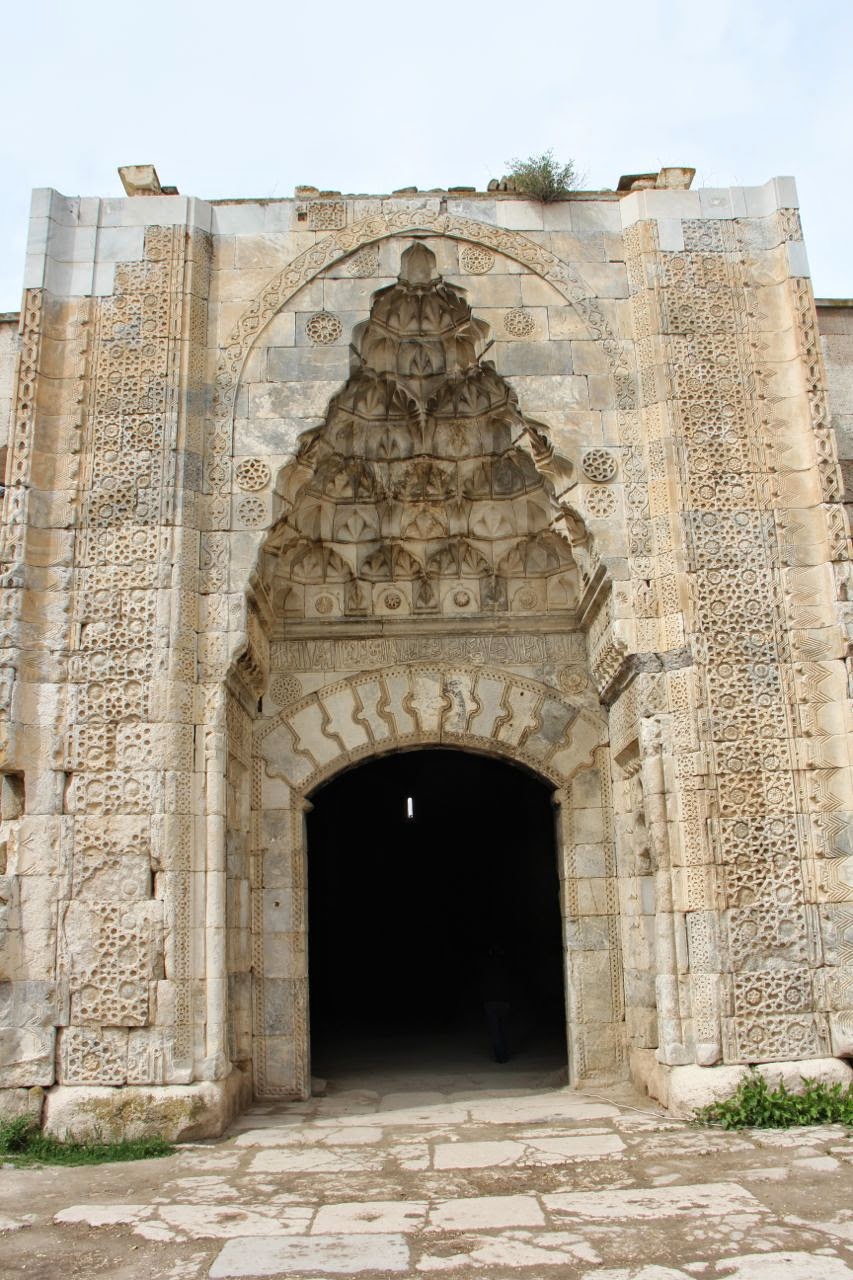
The lone entrance to the complex was through a double fortified iron door set into  a giant marble portal.  
Iron door in portal 
The marble is coloured in veins of pink and blue and white, and decorated elaborately  in patterns similar to some that are on the carpets and fabrics they have rolled on their camels’ backs for trade: geometric, interlocking, intricate.  Typical of the times.  In this year of Allah, being 1229.  It is beautiful.  One of the most beautiful porticos they have seen.  
Exquisitely adorned
Leading their camels through the portal the traders felt as if they are walking into a royal palace.  They rarely saw such luxury. The great external walls of tuff enclosed a massive open courtyard: built for days when the weather was fine and fair.   Here the camels could spit and snort and sleep after their packs had been unrolled, and the caravanserai animal doctor might find time to dress Ahmid’s wound, and, Allah be praised, lance Rashid’s ailing tumour.   And the animals would be given fodder, and be rested by the porters.  Life was good.  

Open courtyard, arched on all sides
Tonight, though, the weather bodes poorly.  Traders and animals will need to be moved into the covered arched courtyard to the right, for shelter from the wind and mayhap, later, the rain.    Here, they are beseeched to throw down their travel packs and their beddings, and rest.

For three days they are welcome here, quite freely and looked after thoroughly by the Selçuk  folk.  This is their way. A welcome for long distance travellers.  A kindly attendant brings across a tray of small silver goblets filled with a warmed infusion from the Mutfak.   It is refreshing. They sit on their rugs sipping and watching for the few minutes they have before the call to prayer in the mosque.
Arched beauty in the passages
With lamps and torches lit all over the caravanserai they can now take time to see the new mosque.  It stands on decorative arches and rises up a second story.  It is the only structure permanently built occupying space in the courtyard.  Its walls, too, are covered with interesting and intricate designs. The architect really was an artist.  One of the best in Anatolia. Though it has been said that he is a Syrian from Damascus by the name of Muhammed Bin Havlan El Damasci.   But still, a fine architect, to have accomplished all this. Such beauty may last forever.  
Intricate Moorish influences
On the far side of the courtyard they can see rooms with doorways. They make out the kitchen with its tandoor oven and can smell the charring of the bread, meat and peppers they will likely be offered for their evening meal.  Already they are salivating.  Further down, one of the doorways leads to a hammam.  Later, they will bathe and have a massage and, Allah be praised, all the aches and pains of the day will be rubbed away.  

The call to prayer echoes around the covered courtyard, and they reach for their beads, wash, and spend time on their knees in the mosque thanking Allah for this day.  

After prayers they take time to explore the massive structure at the rear of the palace.  This is entered through another elaborate portico, which they can see is richly decorated in the soft light of lamps. 
Another gorgeous portico
Inside is a monumental space filled with arches and a domes, like a grand basilica, illuminated only by arrow slits letting in the last rays of evening light, making it feel warm and cosy and welcoming.  

Arches everywhere
Various corners are occupied by merchants, ready and eager to trade goods for those of the camel traders. This is where they can gather any supplies they are running short of.  Here, too, they can sit and talk.  Not just with other camel traders, but with all kinds of travellers: pilgrims, noble folk, strangers from different lands who have also come a long way and are resting here.
Traders gathered under the dome
Here, under the dome, they can spend the evening, catching up on the latest news and commerce of the region as they trade their trinkets and treasure, followed by dinner,  before they return to a welcoming bedroll.  
Artifacts of the age 
Outside, the windstorm begins to rage as night falls heavily, but Allah be praised, all is right with the world behind these walls.  Tonight they can rest safely, with food in their bellies, and their animals watered and snoring.   

What more can a busy traveller need?

oooOOOooo

Monday, 5 May 2014

A city like no other

Around 9,000 years ago people still wandered the earth like nomads covering vast tracts of land following the movement of the animals, very likely, in order to survive.  

Obsidian tools used to bring down the beasts
But, at Çatalhöyük, something inspired prehistoric man to stop wandering,  to begin to construct more permanent housing where people could stay longer.  Mud huts were built side by side.  Homes formed together as a group,  gradually forming a settlement. Perhaps the environment was a stimulus: there were reeds here, for thatching, marshes to catch fish when animals were thin on the ground, and peaty mud that could easily be made and dried into neat, even bricks that could be glued together with the watered down clay.  

So a settlement formed.  Over time it came to have something like 8,000 people living in it.  Virtually a city.  In truth, one of the earliest cities ever built anywhere in the world.  Possibly only Jericho, further south, is older.   Çatalhöyük is certainly the oldest city found in the land that is now known as Turkey.  

It was discovered by a team of archeologists led by James Mellaart not so long ago.  In 1958.  Mellaart sought funding and brought back excavation teams for four seasons between 1961-1965 revealing a discovery that had the rest of the world enthralled as they learned more and more about one of the first cities ever built on earth.   Mellaart fell foul of the government and was not allowed to continue his work but, in 1993,  Ian Hodder was given 25 years to continue the research and each year teams come from all over the world to contribute to the work unfolding here. 

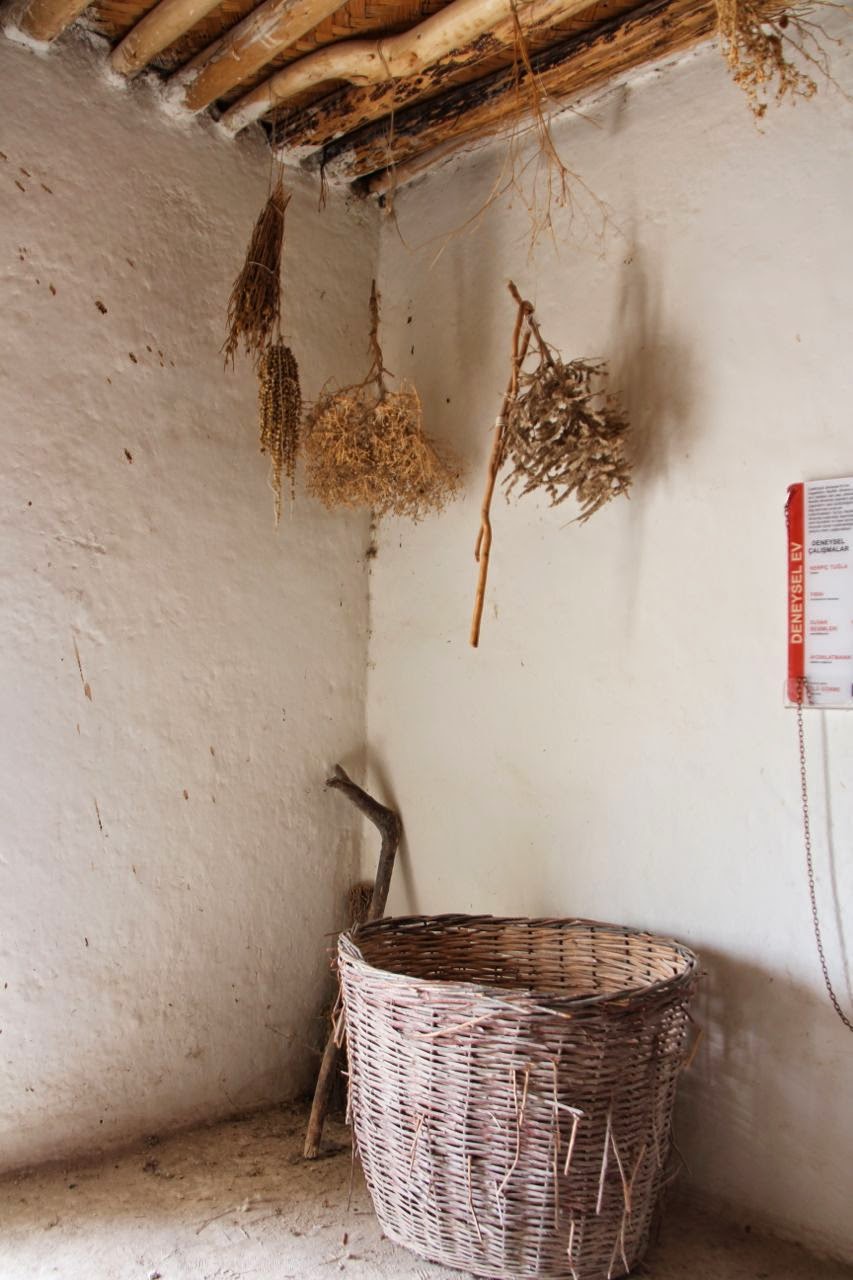
So Çatalhöyük is very much a working site.  There are permanent buildings on site that now form a small museum though the main finds are on display in Ankara and Konya archeological museums. There are dig headquarters and specialist rooms for animal bones, bone tools, plant remains, human remains and site building material.  There is accommodation and living facilities for the excavation teams that come each summer, a guard house, and an experimental model house set up on the grounds to test theories formed onsite.  

On the two mounds that hold the city that once rose up out of the marshes are two purpose built structures that cover and protect the dig.  There is a small path between the two and we were allowed to wander freely, after an introduction by the guard.  

Eastern bound exposed dig
The first site of  Çatalhöyük takes your breath away.  The houses are built quite separately and completely.  Not like terraced houses of today which share a communal wall.  These houses are tucked tightly together against each other, external wall against another external wall.  Tight. Close.  There are no alleyway, and no streets. 

The walls of two adjoining houses
The houses are of the land, mud brick, with pole supports for the roof which offer support to prevent it caving in. 


Neat mud brick work
But the dwellings do cave in. The homes seem to last about 80 years, then another is built on top of it, then another.   Layer upon layer upon layer of built up houses side by side and atop, were built and rebuilt over many thousands of years.  

With no paths, lanes or alleyways.

Access was through holes in the roof, using ladders.


Ladder access through the roof
So the flat roof tops of the buildings might have been a bit like the Italian piazzas of today.  Meeting places, but at different levels accessed by smaller or taller ladders.  Here, people likely gathered to talk, have a cup of warmed spring water infused with herbs, lay their washing out to bake dry, and to chat about what they might have for supper tonight.  


Useful terrace roof tops 
Or, where to bury grandma.  

Çatalhöyük burials, like many Lycian burials, were kept close to the living.  The dead were often buried in pits under a stone that when covered with a reed mat became a bed for the family.  Sometimes as many as 60 bodies were buried in the one cavity beneath a floor surface in one of the rooms.  Really close.  

Wall ornamentation and bed
above gravesite 
Wall art has been found in some such rooms. On walls rendered with fine sticky clay.  And some theorists put forth the notion that such art might be there to honour the dead. Or, it might simply be decoration.

Beautiful stylised art representations
   
So, Çatalhöyük homes and roof top terraces seem to be all inclusive in their functionality,  they not only operate as homes, but also as meeting places for decision making in lieu of dedicated public meeting houses.  As well, they are places of spiritual practise, often decorated with art.

Probably the first ever shaker found on earth
Pass the pepper, please
We loved it.  This was one of the highlights of our trip.  We have been looking forward to the dig and were completely enthralled by all of it.

Another corner of the experimental house
Mind you, today, the area is not as it once was.  This is flat steppe land, virtually treeless.  It appears to be the bread basket of Turkey as irrigated grain crops stretch as far as the eye can see.  

Where the women bend and the men direct
We also came across many more yorek encampments over these high plains, and dusty villages, themselves with many buildings of mud brick and render, along with a touch of reed thatch, after the style of Çatalhöyük.  Making use of the local environment.  

Construction methods have not varied, even today


oooOOOooo

Sunday, 4 May 2014

Sunday in Konya

Sunday is not a day of rest for the women folk in rural Turkey. So many were hard at work in the fields as we were driving this morning.   


Even on a Sunday


At one stop we came across a lovely old man collecting fresh mountain spring water from a community well beside the road using his donkeys as transport. This is likely his only source of drinking water.  
Old man and his donkeys
He was happy for us to take a photo before he headed off on his rustic route, back home into the hills.

Rickety but roadworthy

We drove into Konya, a heavily populated city, but very windy today, and coated in a pall of dust.  Practically every road, in and out of the city, is being rebuilt. The work is phenomenal and extensive, but it is creating this heavy layer of dust hanging in the air that you can taste on your tongue.   Plastic bags and paper litter from the sides of roads were being lifted by the wind until they were hooked onto fences around the city.  Not at all appealing.  It gave the city a third world aspect, and litter is something the Turks really have to begin to deal with, as they are certainly not the world’s best at picking up their trash and roadside rubbish.  


The further in to the city we went Konya revealed itself more as a city of parks and mosques.  There are mosques on practically every block: some of them very beautiful.  Which is understandable, as this city, once the capital of the Sultanhate of Rum, is still the heart of conservative Sufiism.  This is where the Whirling Dervish religion had its roots.  The founder, Rumi, buried here, is as revered today as he was back in the 13th century when he became the leading light of the city with his poetry and religious philosophy.


Minarets all over the skyline
Along with thousands of others, mainly Turkish visitors, we visited the tomb of Rumi in his elaborate mausoleum.  His body lies under a green dome, and is covered in rich brocade decorated in gold thread. Mausoleums for his father and other family members surround him and various spaces contain many elaborate gifts from various visiting Sultans throughout the ages.


Rumi's elaborate mausoleum.
His headpiece on the brocade. 
We visited the neighbouring lodge for Rumi’s apostolate, the Whirling Dervishes, which is now a museum of their life and times containing Dervish prayer rugs, musical instruments, clothes and gilded books of poetry and prayer, some in the most exquisite calligraphy. 


Practicing the sema,  the trance dance

The Matbah, or the kitchen, was the centre of the lodge, and where their food preparation and training took place.  New candidates to the Dervish order would spend three days, here, on a rug, observing the efforts that went on in the Matbah in order to decide if they really wanted to continue their vocation.  If they were successful, they then spent a further 1001 days in training to become a Dervish.  


Dining at the lodge
They lived and died within the confines of the Dervish rule.  Their small cells, sometimes shared two apiece, surrounded the courtyard and had floor kilims and sofa beds for sleeping, thinking, studying, praying and storage.  

Praying using large round beads in his cell
There were different duties as they progressed through the ranks of the order.  One of the lodge members was in charge of this lovely velvet purse embellished with gold and pearls holding the key to the gates of the tomb of Rumi.  This he would wear round his neck on special religious holidays and Fridays. 

Key to the tomb gates is in the purse
   In death, the Dervish were buried in the nearby cemetery, close to Rumi.

Dervish cemetery
The only hill in town is a massive artificial mound specially constructed during the Selçuk period so that the Selçuk nobles might build their homes high and look down upon their city.  Today was a Sunday and the park and streets of the downtown were filled with crowds of people, hundreds upon hundreds, walking, sitting on the grass, visiting the mosques, picnicking, all very provincial still, all with their backs to the wind.

Crowds of traditionally dressed visitors everywhere

We treated ourselves to lunch at the Konak Konya, a renowned restaurant that has been written up in many international gourmet magazines as being one of the best in the region, its service second to none.   We could only manage two courses, as it was all so filling,  the first being their famed soups.   I tried their traditional yoghurt soup made with yoghurt, flour, rice, chickpea and mint, which had fried butter drizzled over the top. The others ordered the gombo, or wedding  soup, that looked like a spicy tomato soup with dried gombos added, which we have not seen or heard of before. These gumbos were shaped like tiny gum nuts, but had the texture of soft lentils, and were cooked with mince, onion and butter.  
Gourmet soups
We then had an assortment of roasted lamb with aubergine, another lamb dish with roasted bread chunks, used often in peasant cuisine,  and whole spicy roasted onions and  peppers and tomatoes for a salad.  No wine, of course, as Konya is a dry town and no alcohol is served.  Everything was delicious and they looked after us so well and all for the princely sum of $AUD8 per person.  Extraordinary.  

Delicious mains
We spent much of the afternoon in the hill park with more crowds of people visiting the Alaeddin Mosque, another Selçuk mosque featuring wooden poles, and we are becoming quite a fan of the wood and stone combination of this Selçuk architecture.   


Alaeddin Mosque
This mosque is called the Throne of the Gods, as many important Selçuk rulers have been buried here through the ages.  

Amazing number of people just out and about today: despite the wind which has been constant.  
Many rulers are buried here
oooOOOooo